

Introduction
Why do people really buy things?
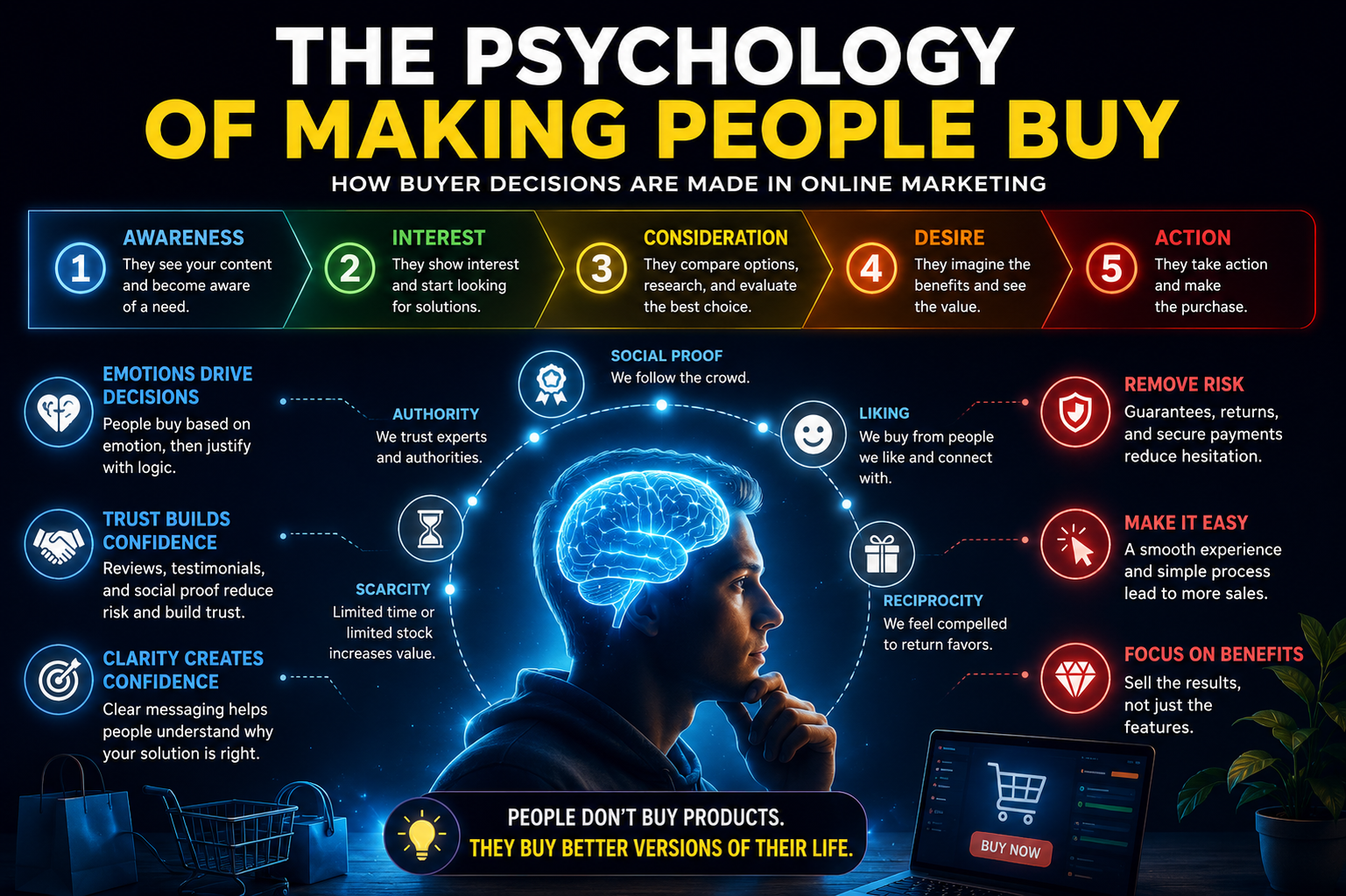
It’s rarely the specs, the features, or even the price. Most of the time, people buy a feeling — belonging, confidence, relief, status, or safety — and the product is just the vehicle that delivers it.
Buyer psychology (sometimes called psychology-based marketing) is the practice of understanding these deeper emotional and identity-driven motivations behind a purchase, then shaping your content, offers, and messaging around them, instead of simply listing what your product or service does.
This matters if you’re trying to build an income online, whether through a blog, affiliate marketing, freelance services, or digital products. Most beginners default to feature-dumping: “here are ten things this tool can do.” But the creators and brands that grow fastest are usually the ones who figured out the why behind the buy, and positioned themselves accordingly.
Understanding buyer psychology won’t turn a weak product into a bestseller. But it will help you communicate value more persuasively, find audiences your competitors are ignoring, and build the kind of trust that keeps people coming back — which, for any online business, is the real engine behind consistent sales.
Key Features / How It Works
At its core, buyer psychology rests on a handful of repeatable principles. Here’s what’s actually happening beneath the surface when someone decides to buy:
- People buy the “why,” not the “what.” A phone isn’t just a communication device — for some buyers it can represent privacy, status, or independence. A pair of shoes isn’t just footwear — it can represent belonging or accomplishment. Strong marketing identifies that underlying motivation and speaks to it directly, rather than just listing specs.
- Blue Ocean Strategy — competing where no one else is. Instead of fighting for the same crowded market as everyone else, successful businesses often look for an adjacent, underserved space. When Honda first tried selling motorcycles in the U.S., it couldn’t compete with Harley-Davidson’s power and prestige. Almost by accident, Honda’s small, lightweight bikes found a completely different audience: recreational off-roaders. That “blue ocean” became an entirely new category — the dirt bike.
- Category creation — same product, new customer. Sometimes you don’t need a new product, you need a new audience. One well-known brand took a commodity, hand soap, and reframed it as a design object for people who cared about aesthetics and sustainability. Another took an existing product, baby wipes, and repositioned the branding and marketing specifically for men. A third took bottled water and, through bold branding and irony, marketed it to people cutting back on alcohol who still wanted an edgy identity. Same core product, completely different buyer.
- Psychological triggers. Researcher Robert Cialdini’s well-known principles of persuasion — scarcity, reciprocity, consistency, and contrast — describe how people naturally respond to certain cues. Used honestly, these aren’t manipulation; they’re simply patterns in how humans make decisions.
- Real scarcity vs. manufactured urgency. There’s a meaningful difference between genuinely limited availability (a freelancer who can only take on three new clients a month) and artificial urgency (a countdown timer that quietly resets when you refresh the page). One builds trust. The other erodes it.
- The PAS framework (Problem, Agitate, Solution). A simple but effective copywriting structure: name a real problem your audience has, explain why it matters, then present your solution. It only works if you’ve identified the right problem for the right audience, rather than repeating what every competitor already says.
What You Need to Get Started
The good news: applying buyer psychology to your online business doesn’t require a big budget or a technical skill set. It’s more about mindset and observation than tools.
- Curiosity about your audience. You need a genuine sense of who you’re writing or selling to — their frustrations, aspirations, and the identity they’re hoping to project.
- Basic writing or copywriting ability. You don’t need to be a professional copywriter, but you do need to be able to describe a problem and a solution clearly. This is a skill built through practice, not something you’re born with.
- A publishing platform. A blog, YouTube channel, social media presence, or email list — anywhere you can consistently put content in front of people.
- A willingness to test and observe. Psychology-based marketing isn’t a one-and-done formula. It takes testing different angles, headlines, and offers to see what genuinely resonates with your specific audience.
- Some foundational reading (optional but useful). Robert Cialdini’s Influence: The Psychology of Persuasion is one of the most widely referenced books on this subject, and a solid place to start if you want to go deeper than this article.
- Time. This is a skill developed over weeks and months of writing, publishing, and paying attention to what actually converts, not something mastered in an afternoon.
Benefits & Challenges
Buyer psychology isn’t a magic formula, but understanding it consistently improves how well your marketing and content perform.
The benefits:
- Differentiation. When you understand what your audience actually wants, rather than what everyone assumes they want, you can position your content or offers in ways competitors haven’t considered.
- Stronger, more resonant messaging. Content built around real motivations tends to convert better than generic, feature-focused writing, which is useful whether you’re writing product reviews, affiliate content, or promoting your own offers.
- Works across income streams. These principles apply just as well to blog monetization and affiliate marketing as they do to freelancing, digital products, or client services.
- Builds long-term trust, when applied honestly. Audiences can usually tell the difference between a creator who understands them and one who’s just trying to extract a sale.
The challenges:
- It’s not a shortcut. Buyer psychology improves how you communicate value — it doesn’t replace having something genuinely useful to offer.
- The ethical line matters. There’s a real difference between persuasion (helping someone see value that’s genuinely there) and manipulation (creating false urgency or misrepresenting an offer). Crossing that line can damage your reputation, and in finance-adjacent niches, your long-term credibility.
- Finding your “blue ocean” takes real thinking. It’s tempting to just repeat what competitors are already doing. Genuinely identifying an underserved audience or angle takes deliberate effort; it rarely happens by accident.
- Results vary and take time. There’s no fixed income figure attached to “understanding psychology better.” It’s a compounding skill that gradually improves conversion rates and audience connection, not a guaranteed payday.
Best Strategies to Get Results
- Look for an audience nobody else is targeting, not just a new angle on the same one. Before publishing your next piece of content or offer, ask who else, beyond the obvious audience, might have this exact problem. That’s often where the real opportunity hides for affiliate marketers and content creators.
- Use honest scarcity instead of fake urgency. If you genuinely have limited time, limited client slots, or a limited-time offer, say so plainly. Real constraints, communicated honestly, are one of the most effective and ethical motivators in marketing.
- Study, and apply, proven persuasion principles. Reciprocity (give real value before asking for a sale), consistency (earn small “yeses” before a bigger ask), and contrast (help people see clearly what they’d be missing) are well-documented psychological patterns. Learn them, then apply them transparently rather than manipulatively.
Common Mistakes & Safety Tips
Beginners exploring online income often make a few predictable mistakes when they first start experimenting with persuasion and psychology:
- Mistaking manipulation for marketing. Fake countdown timers, inflated “X people are viewing this” counters, or invented scarcity might boost short-term clicks, but they erode the trust that actually sustains an online income over time.
- Copying competitors instead of doing the thinking. It’s easier to mimic what everyone else in your niche is already doing than to find your own underserved angle, but it’s also far less effective.
- Overpromising income or results. Especially in the “make money online” space, be cautious of, and avoid producing, content that guarantees specific earnings. Realistic, honest framing builds more durable trust with your audience than hype does.
- Neglecting the actual product or offer. No amount of persuasive framing fixes a genuinely weak product, service, or affiliate offer. Psychology amplifies real value — it doesn’t invent it.
- Falling for these same tactics yourself. Because scarcity, urgency, and social proof are so persuasive, they’re also commonly used by low-quality “make money online” courses and schemes to pressure beginners into buying. If you notice fake countdown timers, vague income claims, or extreme urgency pushing you toward a purchase, treat it as a red flag rather than a reason to act fast.
Conclusion
At its heart, the psychology of making people buy isn’t about tricks or manipulation. It’s about understanding why people actually make decisions, and communicating your value in a way that genuinely resonates with that.
Whether you’re writing affiliate content, building a blog, or offering your own services, the creators and brands that grow fastest usually aren’t the ones with the flashiest features. They’re the ones who found the right audience and spoke directly to what that audience actually cares about.
Start small. Pick one piece of content or one offer, and ask yourself honestly: what emotional need is this really meeting, and who is most likely to feel that need? That single shift in thinking is often where real, sustainable growth in an online business begins.