

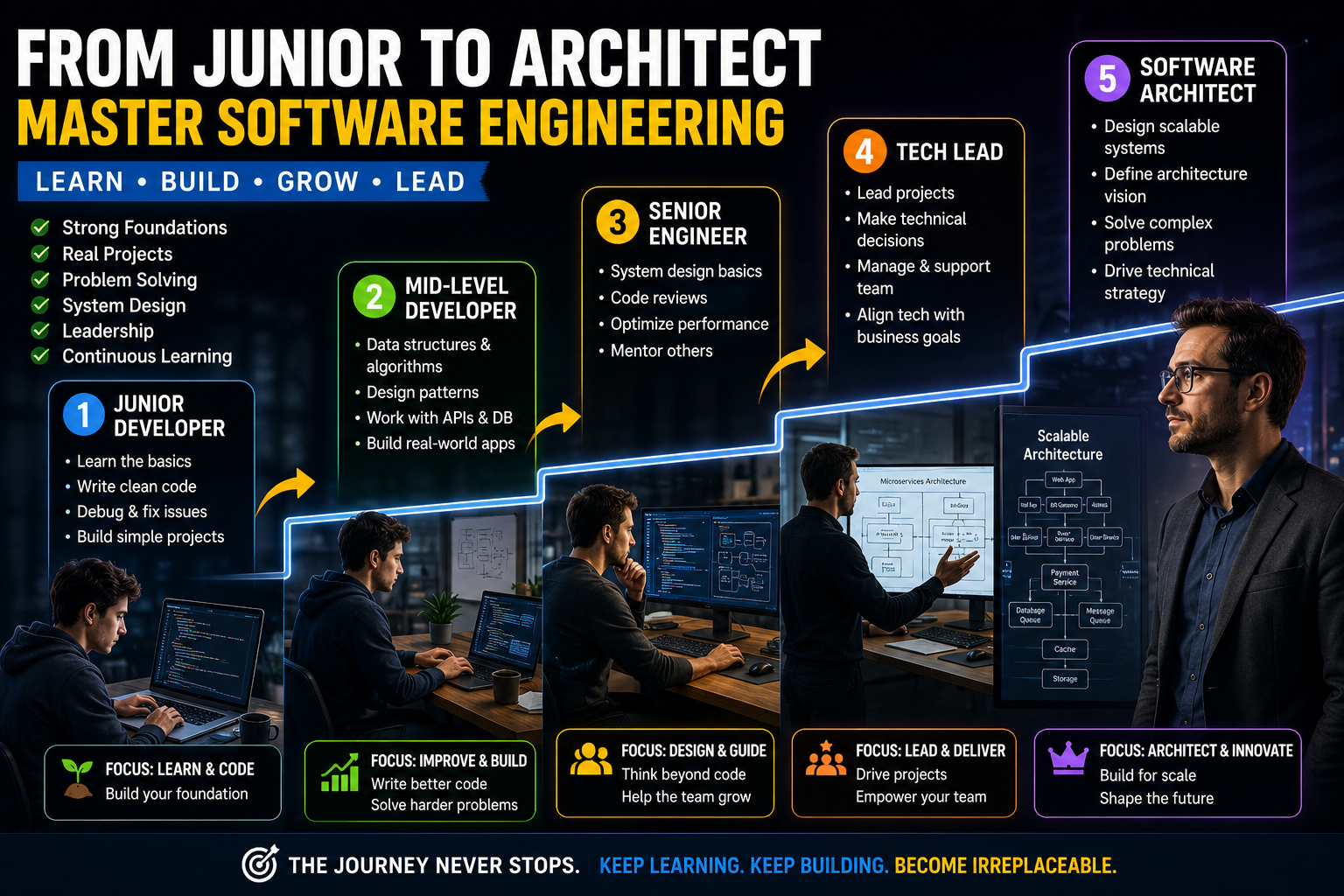
Introduction
Mastering software engineering isn’t about knowing every programming language or framework that exists — it’s about developing real depth in your craft, building genuine problem-solving confidence, and learning how to keep growing without becoming overwhelmed by an industry that never stops changing.
This matters whether you’re a junior developer just starting out, or you’re aiming for a senior or architect-level role (and the income that comes with it). The path isn’t about chasing every new trend — it’s about building a strong foundation, letting real-world problems guide your learning, and developing the judgment to know when “good enough” truly is good enough.
This guide breaks down a practical, experience-based roadmap for leveling up as a software engineer, based on lessons from someone who’s spent over two decades doing exactly that — moving from hands-on developer to CTO and architect.
Key Features / How It Works
Here are the core principles behind mastering software engineering as a long-term craft:
- Let real problems drive your learning, not just curiosity. Rather than trying to study every technology that exists, focus your learning on what’s actually required by the projects and problems in front of you. This keeps your skills practical and relevant instead of scattered.
- Master the fundamentals of your programming language first. Truly understanding your core language — not just using it, but grasping why it works the way it does — makes it easier to read other people’s code, understand design patterns, and write clearer code yourself.
- Read other people’s code, especially well-built open-source projects. Studying mature, well-engineered codebases teaches you patterns and approaches you won’t find in tutorials alone.
- Go deep before going broad. Trying to learn “a little bit of everything” early in your career (front-end, back-end, cloud, DevOps, all at once) often leads to shallow knowledge across the board. Depth in one area first builds the confidence and problem-solving ability that makes learning everything else easier later.
- Build a feedback loop between what you build and how it performs. Being able to see logs, metrics, and real production behavior for the systems you build is one of the fastest ways to grow past a junior skill level.
- Understand integration. As more companies rely on multiple software services, APIs, and AI tools working together, integration skills (handling retries, failures, synchronous vs. asynchronous communication, and more) have become a genuinely valuable specialty.
- Practice pragmatism. Not every project needs enterprise-grade scalability or resilience. Learning to judge how much engineering rigor a given problem actually needs is a skill in itself — and one that separates senior engineers from junior ones.
What You Need to Get Started
You don’t need a specific degree or an expensive bootcamp to start building real software engineering mastery. Here’s what actually matters:
- A solid grasp of one programming language. Pick one and learn it deeply before spreading yourself across many.
- Access to real or realistic projects. Whether through a job, freelance work, open-source contributions, or personal projects with genuine complexity, hands-on problem-solving is where real learning happens.
- Curiosity paired with persistence. Being willing to sit with a hard problem — and being comfortable feeling “uncomfortable” while learning something new — is described as essential to long-term growth in this field.
- Willingness to ask for help at the right time. Struggling productively teaches you the most, but knowing when to ask a colleague for help (after you’ve made a genuine attempt) saves time and builds better collaborative habits.
- Exposure to production environments. If your current role or projects don’t let you see how your code performs in the real world, that’s a sign to look for opportunities that do.
- Time. Real mastery, especially at the architect level, builds over years of consistent, focused problem-solving — not weeks.
Benefits & Challenges
The Upside
- Strong earning potential. Software engineering remains one of the most in-demand, well-compensated technical career paths, with clear progression from junior developer to senior engineer to architect or CTO-level roles.
- Transferable, durable skills. Deep fundamentals (understanding your language, integration patterns, system design) stay valuable even as specific tools and frameworks change.
- Flexibility across industries. Software engineering skills apply across finance, healthcare, government, e-commerce, and virtually every modern industry — including online business and digital entrepreneurship.
The Honest Challenges
- The field never stops changing. New frameworks, tools, and best practices emerge constantly, and trying to keep up with everything can lead to burnout or shallow, unfocused learning.
- Some environments limit your growth. Working in an organization with too much process, too little trust, or no visibility into how your code performs in production can stall your development, even if you’re putting in real effort.
- Depth takes time. There’s no shortcut to genuine mastery — it requires sitting with difficult problems and learning from real mistakes, which can feel slow, especially early in a career.
Best Strategies to Get Results
- Let your job (or projects) define your learning path. Instead of trying to study everything, focus on the specific technologies and problems your current work actually requires. This keeps learning purposeful and prevents the overwhelm of trying to master the entire tech landscape at once.
- Prioritize integration and system-thinking skills early. As businesses increasingly rely on multiple connected services, APIs, and AI tools, understanding how systems talk to each other — reliably and resiliently — is becoming one of the most valuable and durable specialties a developer can build.
- Build visibility into your own work. Push for access to logs, metrics, and real production behavior wherever possible. Seeing how your code performs in the real world creates a feedback loop that accelerates learning far faster than working blind.
Common Mistakes & Safety Tips
- Don’t try to learn everything at once. Spreading your attention too thin as a junior developer often leads to broad but shallow knowledge, which can make career growth harder later.
- Avoid skipping the fundamentals. Jumping straight into frameworks or AI-assisted coding tools without understanding the underlying language or concepts can leave gaps that show up later as bugs or poor architectural decisions.
- Don’t over-engineer solutions that don’t need it. Applying enterprise-grade complexity to a simple, short-lived project wastes time and can actually increase risk rather than reduce it.
- Be wary of environments with no feedback loop. If you can’t see logs, metrics, or the real-world results of your work, it’s much harder to grow — this is a red flag worth addressing or, if necessary, leaving for a better opportunity.
- Don’t confuse busyness with mastery. True skill comes from solving real problems deeply, not from collecting certifications or dabbling in many tools without depth.
If you’re building your foundational skills, reputable, well-documented resources like the official documentation for your chosen language or framework, combined with studying real open-source codebases, tend to teach far more than most paid “quick mastery” courses.
Conclusion
Mastering software engineering — going from junior developer to architect — isn’t about chasing every new trend or trying to know everything. It’s about building real depth, letting genuine problems guide your learning, and creating feedback loops that let you see the results of your work.
Combine strong fundamentals with curiosity, persistence, and the judgment to know when simplicity is the right choice, and your growth will compound over time.
The path takes patience, but as this conversation makes clear: it does get easier. Once you understand the underlying patterns, learning the next language, framework, or system becomes far less intimidating than the first time around.