

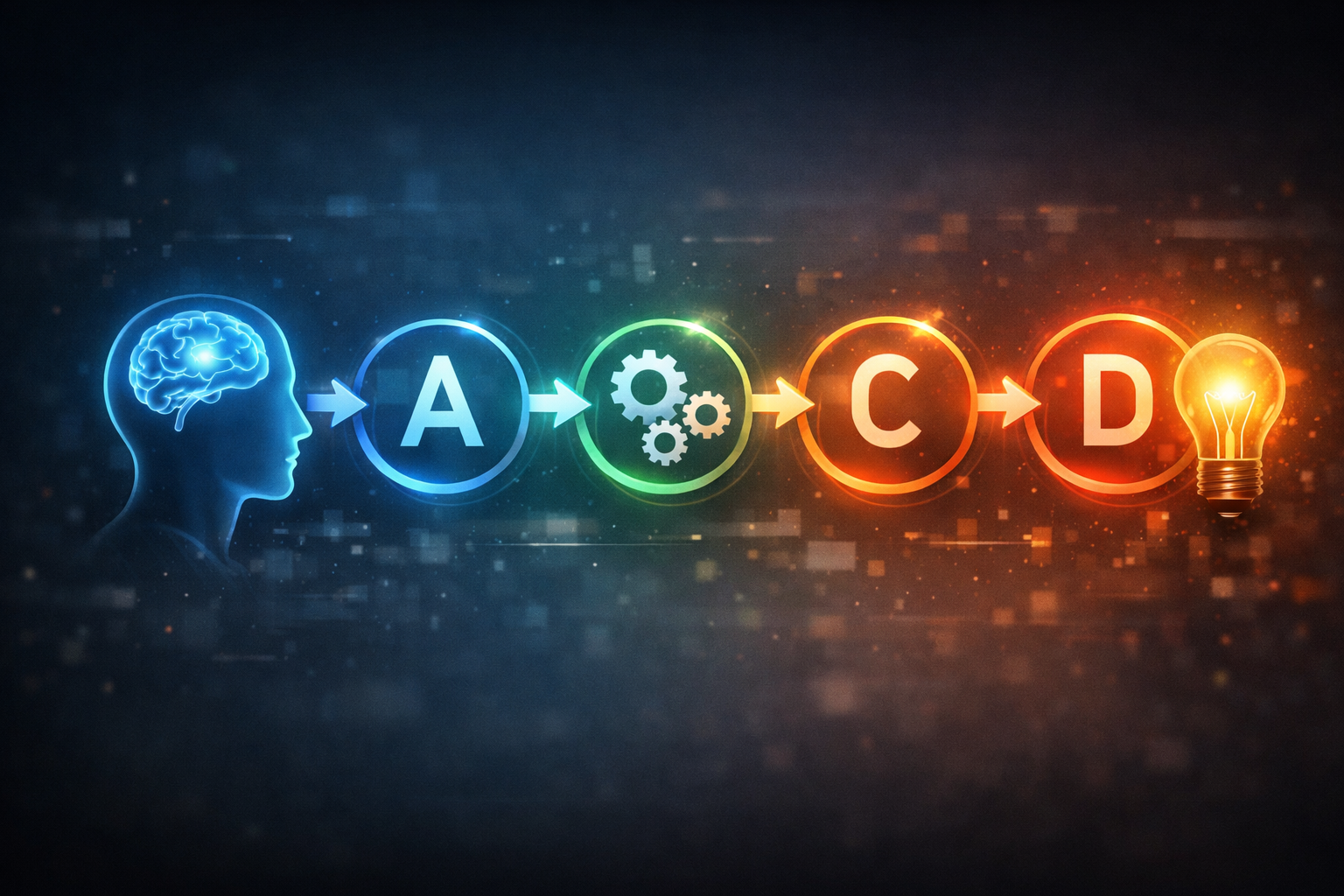
Beyond the Test: Why Problem-Solving is the Only IQ Metric That Matters
The Misunderstood Metric: An Introduction
In our hyper-connected discourse, “Low IQ” has devolved into a lazy linguistic shortcut—a casual slur aimed at those we find disagreeable. Yet, this weaponization of intelligence ignores the actual cognitive architecture that defines a high-functioning mind. True intelligence isn’t a static number residing in a dossier; it is a visceral, real-time response to systemic friction.
Our cognitive architecture reveals itself most clearly at the moment of failure. The fundamental divide between “Low” and “High” IQ isn’t found in a person’s ability to memorize facts, but in their immediate reaction to a challenge. It is the difference between a mind that freezes under pressure and one that instinctively begins to map a path through chaos. To understand intelligence, we must move beyond the test and look at the mechanics of the solution.
The “Watcher” vs. The “Creator”
When faced with a novel obstacle, human reactions bifurcate into two distinct neural patterns: passive observation and active creation.
In individuals exhibiting a “Low IQ” response, we observe a notable lack of creative momentum. When a system breaks, their cognitive process halts. They become “Watchers.” Lacking an internal blueprint for action, they wait for a external template to follow or for a leader to provide a direct path. This is a survival mechanism of the collective, but it represents a lack of individual cognitive sovereignty.
Conversely, the “High IQ” response is characterized by an immediate “urge to invent.” Rather than scanning the environment for a person to follow, these individuals begin building a mental map. They do not see a roadblock as a signal to stop; they see it as a prompt to create a new heuristic. They are “Creators” who treat every challenge as a puzzle requiring a bespoke key.
The A-B-C Framework of Troubleshooting
The most transparent way to observe these cognitive archetypes is through a technical failure, such as a malfunctioning smartphone. The procedural difference in how one approaches a broken tool reveals their internal logic.
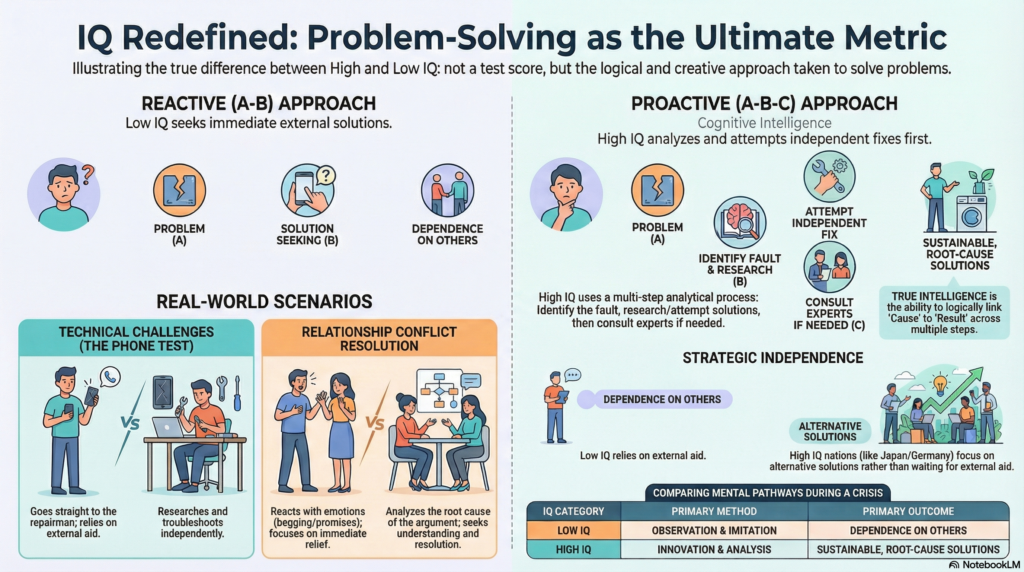
- Low IQ (The A-B Logic):
- Phase A: A problem is identified (The phone stops working).
- Phase B: The individual immediately seeks an external expert or technician to provide the solution.
- High IQ (The A-B-C Logic):
- Phase A: A problem is identified.
- Phase B (The Investigation): This is the critical differentiator. The individual engages in self-led research. They may physically open the device (furfuro), search the internet for troubleshooting guides, or test variables to isolate the cause.
- Phase C: Only after exhausting their own resources and identifying the specific need for specialized tools or knowledge does the individual consult an expert.
“Intelligence is found in the refusal to skip the investigation phase; it is the courage to navigate the ‘B’ before demanding the ‘C’.”
Solving for Root Causes in Relationships
The A-B-C framework isn’t limited to hardware; it is equally applicable to the “murmuring” of emotional and interpersonal friction. When a relationship experiences conflict, the “Low IQ” approach typically relies on primitive emotional management. It involves begging, making empty promises, or simple obedience—actions designed to stop the feeling of the conflict without ever touching the mechanics of it.
The “High IQ” individual treats a dispute as a system failure that requires a root-cause analysis. They engage in a three-step logical process:
- Analyze the Root Cause (A): Identifying the specific trigger of the discord.
- Identify Contributing Factors (B): Mapping the stressors and behaviors that amplified the issue.
- Predictive Modeling (C): Foreseeing future outcomes based on the current trajectory.
Crucially, this cognitive process leads to a decisive action (go’aan qaataa). They don’t just feel the problem; they solve it by making an informed choice that prevents the conflict from recurring.
The Logic of “Cause and Effect” as a Shield
At its core, high intelligence is the ability to logically link cause and result across a complex chain of variables. If an individual can map the relationship between A, B, C, and D (where D is the ultimate result) and demonstrate how these factors influence one another, they have achieved the hallmark of high cognitive function.
This chain of “Cause-Result” logic serves as a primary defense. Regardless of formal education, social standing, or standardized test performance, if you can accurately identify why a situation occurred and predict the outcome of your intervention, you are operating at a high level of intelligence. Logic is the ultimate “shield” against the “Low IQ” label—if you can solve the problem, the label simply does not stick.
The Global IQ Illusion and the Sovereignty of Solutions
The source context addresses a controversial global application of IQ: the ranking of nations. Regions like Africa are often labeled with lower collective IQs because they are perceived as failing to solve internal problems—such as peace-building or technological development—without external intervention. In contrast, nations like Japan and Germany are viewed as “High IQ” because they excel at finding alternative, independent solutions.
However, we must recognize the “false balance” (misaan beenta ah) inherent in this metric. Comparing a nation’s struggle to achieve basic internal reconciliation with another’s ability to build and launch satellites is an exercise in ignoring reality (iska indhotirka xaqiiqada). These rankings often measure a nation’s resources rather than its innate logical potential. While the global community uses these hierarchies to define “intelligence,” the true metric remains the same: the sovereignty of a nation’s problem-solving process.
Conclusion: The Logical Path Forward
Intelligence is not a fixed inheritance; it is a cognitive muscle exercised through the A-B-C process of independent investigation. To elevate your own intellect is to transition from a “Watcher” to a “Creator.” It requires the discipline to look at a failure—whether technical, emotional, or professional—and refuse to skip the “B” phase of investigation.
The next time you face a breakdown, observe your own reaction. Will you look for someone to watch, or will you start the search for “C”?