


Beyond IQ: What 500 Successful People Taught Me About the Real Path to Greatness
The trajectory of a life can change in the space between two cities. For Dr. Richard, that moment occurred mid-flight while sitting next to a high school student. She came from a family trapped in poverty, but she carried a burning ambition to change her family’s fortune. She turned to him and asked a question that seemed simple yet proved impossible to answer in the moment: “How do you actually achieve success?”
Stunned by his own inability to provide a roadmap, Dr. Richard embarked on a seven-year quest to find the truth. He conducted 500 interviews with individuals at the absolute pinnacle of their fields.
In our society, we often use the label “Low IQ” to dismiss those we deem incapable. We treat intelligence like a fixed inheritance—you either have it or you don’t. But through these 500 interviews, Dr. Richard discovered that the “Low IQ” label is a hollow myth. True greatness isn’t a matter of genetic luck or a high test score; it is a structured process. What follows are the eight traits—the real markers of capability—that separate the dreamers from the achievers.
1. Passion Over Profit (Hilow)
The first pillar of greatness is Hilow, a deep sense of desire and longing for one’s work. A common misconception is that the elite are driven by the pursuit of money. In reality, the most successful people are fueled by a passion so intense it keeps them awake at night.
When you work because you truly enjoy the process, you naturally invest more creativity and effort. Successful people don’t just work; they thrive in the doing. This dedication eventually attracts wealth, but if you work strictly for the paycheck, you will never find the endurance required to reach the summit.
2. The Myth of the Easy Path (Shaqo)
True success is never “cheap.” The principle of Shaqo (Work) dictates that there are no “free” or comfortable beginnings. Many people look for a low-value, easy start, but high achievers understand that greatness requires total immersion (siqota dheer) and significant sacrifice.
They do not shy away from the struggle; they embrace it. If a path is easy and requires no effort, it is riqiis—cheap and of little value. To reach the top, you must be willing to dedicate your time and your very self to the grind.
3. Mastery Through Repetition (Tababar)
Success is not the result of magic, a “lucky break,” or a sudden miracle. It is the product of Tababar—consistent training and relentless repetition. To become a “Master” in any field, you must abandon the hope for a shortcut and commit to the discipline of practice. Greatness is earned in the thousands of hours spent repeating a task until it becomes second nature.
4. The Power of Monomania (Hadafkaaga Beegso)
Focus on a single target. One of the most dangerous traps in personal development is trying to accomplish ten different things at once. Success requires “monomania”—the ability to live and breathe a single goal day and night. You must keep your eyes fixed on your objective whether you are awake or asleep, ensuring every ounce of your energy is channeled in one direction.
5. The Internal Push (Cadaadinta Nafta)
To reach the highest echelons, you must master Cadaadinta Nafta, or pushing yourself beyond your current boundaries. You should never be satisfied with your current position; instead, you must maintain a constant forward momentum toward the “highest place.”
As a strategist, I see many fail because of shyness (kaxishoon) or self-doubt. They are afraid to even mention their goals. High achievers do not hesitate; they push through hesitation and refuse to settle for “good enough.”
6. The Shortest Route is Service (Dadka U adeeg)
There is a profound difference between a “selfish achiever” and a “value provider.” The principle of Adeeg (Service) suggests that providing value to others is the most efficient path to success.
Consider the metaphor of endurance: the person walking a short distance for themselves gets tired quickly. Their horizon is small, and they feel every ounce of fatigue. However, the person walking a long distance to serve others—the one with a long horizon—does not even remember the fatigue. Their commitment to the collective good gives them the stamina to travel distances that others cannot.
7. Consistency Trumps Intensity (Raadi fikrado cusub)
Many people wait for one “big break” to change their lives. In reality, success is the accumulation of many small, nurtured ideas that are consistently applied. It is the sum of small wins, not a single explosion of luck.
“The small drop that falls on the ground continuously digs a hole, but a full bucket poured on the ground at once cannot dig a hole.”
8. Persistence Through Failure (Haka Harin)
The final key is Haka Harin—the refusal to give up. Along the path, you will encounter failure and the criticism of those who are doing nothing. You must reframe your view of setbacks: failure is not the end of the road; it is a “valuable introduction to great success.” The only true failure is the act of giving up and wasting the potential of your life.
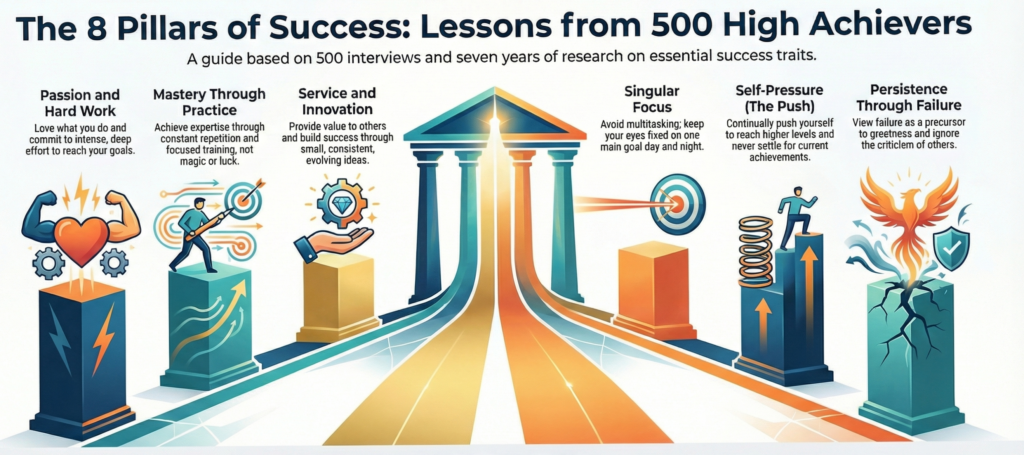
The Blueprint for Your Future
Success is not a gift reserved for a select few; it is a structured path available to anyone willing to cultivate these eight traits. Dr. Richard’s journey proves that the distance between poverty and greatness is bridged by passion, work, focus, and service.
The question is no longer “How do you achieve success?” but rather: Which of these eight traits do you need to cultivate first?