

The common lament of the modern entrepreneur is that the world has become too noisy. They see saturated social media feeds and crowded marketplaces and conclude there is no room left for their ideas.
Seth Godin reframes this fear: The world isn’t noisy; it’s just cluttered with average junk. Most of what we perceive as noise is a race to the bottom—systems designed to hunt people down, steal their privacy, and manipulate them into buying mediocre things. Real marketing is not about joining this cacophony of interruption. It is about creating the conditions for an idea to spread.
To build a brand people actually care about, you must move from “the hustle” toward value creation. Here are the five strategic shifts required to stop making average crap and start building a business that matters.
1. Originality is a Distraction, Remarkability is Non-Negotiable
Originality is overrated. You do not need a revolutionary business structure or a brand-new invention to succeed; in most cases, you should copy the structures that already work. Your creative energy belongs elsewhere: on being remarkable.
Consider the New York City pizza landscape. There are over 5,000 shops in the city, and the vast majority are mediocre. A select few have lines wrapped around the block. These shops didn’t win by mastering an algorithm or using a “secret” social media strategy. They won because they made a product worth talking about.
“Remarkable” literally means “worth making a remark about.” If your product is average, no amount of marketing will save it. If it is extraordinary, your customers will do the marketing for you.
“To be remarkable is to be worth making a remark about… there isn’t a line around the block cuz they’re good at using Tik Tok; there’s a line about on the Block cuz they made a pizza that was worth other people putting on Tik Tok.”
2. The Myth of 40 Million Views
We are conditioned to chase vanity metrics, but being popular is different than being profitable. The “Algorithm Trap” is a black hole for ROI. Godin notes instances where creators gained 40 million views on TikTok only to result in a mere $200 in sales. If your business model requires 40 million impressions to generate $200, you are in serious trouble.
Contrast this with a brand like Festool. They sell a $220 jigsaw—ten times more expensive than the average tool on Amazon. They don’t need 40 million views because they aren’t chasing the masses. They provide a tool so well-designed that, to a serious woodworker, $220 is a bargain.
Chasing mass attention is “Value Capture”—an attempt to steal attention. Building a direct connection is “Value Creation.” Godin’s blog has a million readers without him using TikTok, Facebook, or Instagram. He refuses to play the algorithm game because he has built an audience that seeks him out.
3. The “Smallest Viable Market” Strategy
Most entrepreneurs lack the confidence to exclude people. Driven by fear, they try to appeal to everyone. This is a strategic error. The most effective way to grow is to identify the Smallest Viable Market.
If you start a marketing agency, do not be an “agency for everyone.” Be the agency that only works with pediatric orthodontists. By choosing a tiny, specific group, you stop being “anyone” and start being the “only one.” When you delight a specific niche, a line forms because that community talks to itself.
This works because of the twin engines of Status and Affiliation. People don’t buy products; they buy stories that change their status or reinforce their belonging.
- The Birkin Bag: A $30,000 purse doesn’t hold more than a $50 one. It is a story about status and the tension of being “in” or “out.”
- Toms Shoes: This brand didn’t scale because of the shoes; it scaled because of the logo on the heel. It allowed the wearer to signal to their friends, “I am a philanthropist.”
When you solve a specific problem for a specific group, you give them a story they benefit from telling their friends.
4. Professional Consistency Over Amateur Authenticity
“Authenticity” is for amateurs. Your customers do not want your “authentic” self—they don’t want the version of you that is grumpy, tired, or having a bad day.
When you check into a hotel, you don’t want an “authentically” exhausted housekeeper who left the room a mess. You want consistency. A brand is a promise, and being a professional means keeping that promise regardless of your mood. Authenticity is what you do with your friends; consistency is what you provide to the people you serve. Marketing requires the radical empathy to show up as the best version of yourself—the version you promised the customer you would be.
5. Strategic Quitting: Surviving “The Dip”
Every worthwhile project faces “The Dip”—the difficult period where the initial excitement has faded and success feels unlikely. Most people quit during the dip, which is why they never reach the other side.
However, the counter-intuitive truth is that most people quit too late, not too soon. They start projects they don’t have the resources to finish. Before starting a “marathon,” you must assess if you have the training and the will to reach mile 22. If you aren’t prepared for the dip, don’t start.
Strategic quitting allows you to reallocate your energy toward a project small enough that you can actually survive the struggle. At mile 22, everyone is tired. The winners are simply the ones who “figure out where to put the tired.” Persistence is only a virtue if you have picked a fight you can win.
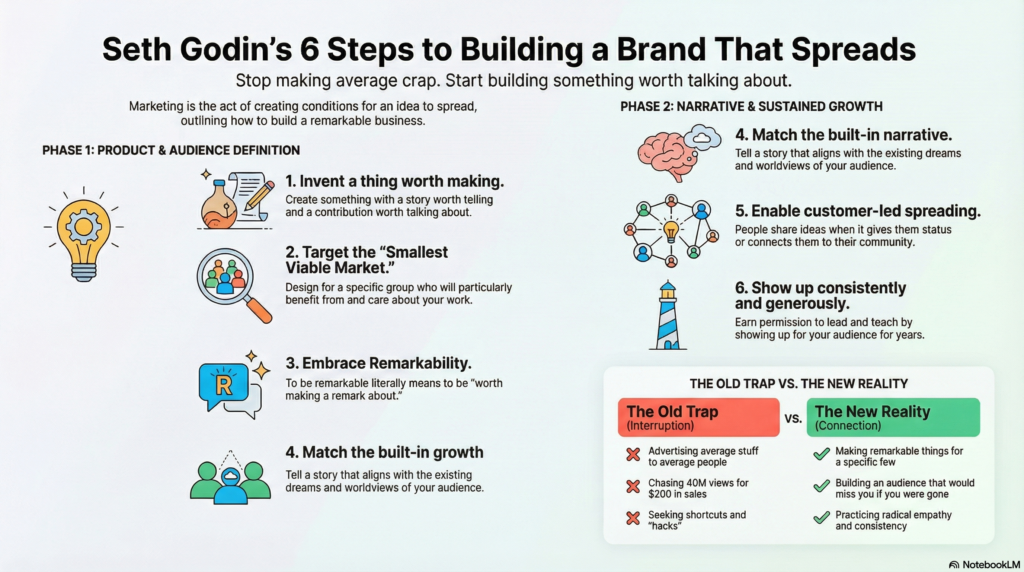
The 5-Step Marketing Blueprint
| Step | Action | Objective |
|---|---|---|
| 1 | Invent | Create a thing worth making with a story worth telling and a contribution worth talking about. |
| 2 | Design | Build it specifically for a few people who will particularly benefit and care. |
| 3 | Narrate | Tell a story that matches their built-in narrative, status needs, and worldview. |
| 4 | Spread | Create conditions where the customer benefits from spreading the word to their peers. |
| 5 | Show Up | Persistently and generously lead for years to build confidence and earn permission. |
Conclusion: The Shift in Identity
Marketing is not a hustle; it is a long-term commitment to value creation. As the economy shifts away from mass-market interruption toward connection, the goal is no longer “Value Capture” (how much money can I take?) but “Value Creation” (how much impact can I make?).
This requires a shift in identity. True marketing is the generous act of helping someone solve a problem. It is about creating something that would be missed if it were gone.
As you evaluate your current work, ask yourself one final, uncomfortable question:
“If you stopped interrupting people today, would anyone actually miss you tomorrow?”