

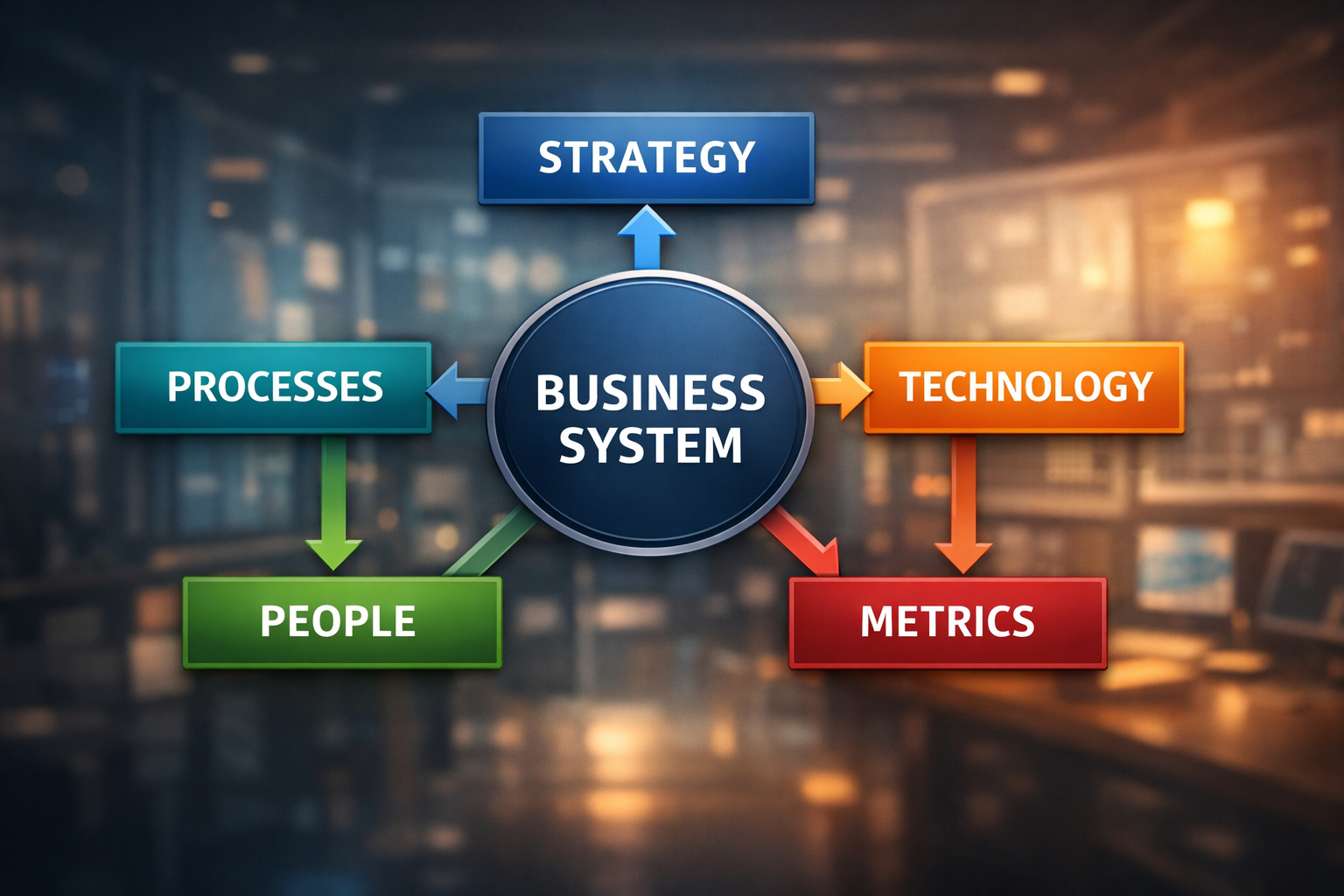
The Anatomy of a High-Value Venture: Understanding the 5 Fundamental Parts of Business
What is a Business System?
A business is not a complex mystery; at its core, it is a repeatable process that creates and delivers value. Whether you are a solo entrepreneur or running a global corporation, every successful venture follows a specific “anatomical” structure consisting of five universal, essential, and fundamental parts. Understanding these parts is a “superpower” that allows you to deconstruct any complex organization and identify exactly where it succeeds or fails.
Key Characteristics: The 5 Vital Organs
Every business that has ever existed functions through these five interrelated processes:
- Value Creation: Identifying an unmet human need and creating a solution people are willing to pay for.
- Marketing: Attracting the attention of potential customers and generating interest in your offer.
- Sales: The process of turning interested prospects into paying customers by building trust and value.
- Value Delivery: Ensuring the customer actually receives what they were promised and remains satisfied.
- Finance: Managing the inflow and outflow of money to ensure the venture is sustainable and profitable.
What Causes a Business to Thrive?
A thriving business is determined by its ability to tap into five core human drives: the drive to acquire, bond, learn, defend, and feel. The more of these psychological drives your business “hooks” into, the more attractive your offer becomes to the market. Success is also driven by rapid skill acquisition; Josh Kaufman notes that you don’t need 10,000 hours to become competent—you can reach a high level of functional skill in just 20 hours of focused, deliberate practice.
Impact on Career & Growth
Mastering this systematic way of thinking has a profound impact on your professional trajectory. It allows early-career professionals to “think like an owner” during interviews and promotions. By focusing on value creation rather than just “playing business” (like obsessing over logos or business cards), you ensure that your efforts lead to actual economic outcomes.
Best Strategic “Positions” for Growth
To ensure your business “shape” fits the market, recommend these specific strategies:
- The Pre-Order Launch: Before investing thousands into a product, ask for early pre-orders or “swiped credit cards” to prove the problem is real and the market is ready.
- The Explore/Exploit Trade-off: Spend a portion of your time exploring new ideas (testing different scents for a candle, for example) and the rest exploiting the ones that prove to be the most profitable
Market Fit and Risk Safety Tips
To prevent your business from “slipping” into failure, follow these practical safety tips for market fit:
- Mitigate Risk with Small Runs: Start with small batches of your product to gather feedback and data before scaling up production.
- Observe Behavior Over Words: People may tell you they like an idea, but their purchasing behavior is the only signal that truly matters.
- Focus on Benefits, Not Features: When selling, don’t just list technical specifications. Focus on how the product improves the customer’s life (e.g., “a thousand songs in your pocket” vs. “one gigabyte of storage”).
Conclusion
Building a successful business is complex, but not necessarily complicated. By focusing on the five fundamental parts and committing to the “First 20 Hours” of learning the necessary sub-skills, anyone can transition from an idea on a sofa to a sustainable venture. Remember that every complex system that works today evolved from a simple system that worked first. Start simple, focus on value, and the rest will follow. Acknowledging these fundamentals is your first step toward true entrepreneurial freedom.